Harnessing Drones for Precision Weed Control in Native Fescue Areas
Phillip Majernik
7/4/20254 min read
Introduction to Drones in Golf Course Management
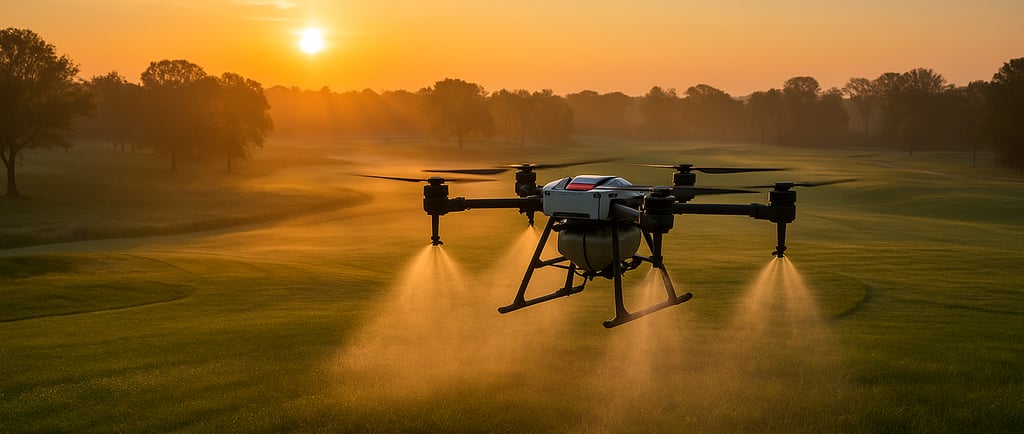
Over my 20 years in the industry, I've seen first hand the integration of technology into golf course management that have evolved turfgrass management to new heights. Among the most transformative advancements is the adoption of drones, or unmanned aerial vehicles (UAVs), which have begun to reshape various turf management practices, particularly in the realm of weed control. Traditional methods often relied on manual labor and heavy machinery, which can be both time-consuming, tough on equipment and resource-intensive. However, the advent of drones presents superintendents with a more efficient and precise alternative.
Drones are increasingly being utilized for a variety of turf management tasks, including turf monitoring, irrigation management, and now, weed control. Utilizing high-resolution imaging and advanced sensors, these UAVs provide superintendents with detailed aerial views of the golf course, allowing for the identification of problematic weed populations without the need for extensive ground surveys. This aerial perspective not only enhances accuracy but also assists in the timely implementation of weed management strategies.
The benefits of incorporating drones into turf management practices extend beyond just weed detection. Drones can facilitate targeted treatments, minimizing herbicide usage and reducing environmental impacts. By precisely applying herbicides only to areas with identified weed infestations, superintendents can achieve better control over weed populations while preserving the integrity of native grass areas. This precision also translates into cost savings, as it lessens the volume of chemicals necessary for effective weed management.
Furthermore, the data collected by drones can be analyzed to inform long-term turf management decision-making. This not only optimizes immediate responses to weed threats but also contributes to more sustainable practices overall. As superintendents increasingly recognize the advantages of these innovative tools, the role of drones in golf course management is expected to expand, cementing their position as essential instruments for efficient weed control in native grass areas and potentially other areas of the golf course.
The Benefits of Autonomous Flight
Autonomous flight technology in drones has revolutionized various industries, including golf course management, by providing precise and efficient solutions for tasks such as weed control in native grass areas. One of the primary benefits of this technology is its ability to enable precise and consistent applications over large expanses in short time. Drones equipped with autonomous flight capabilities utilize advanced algorithms and GPS mapping to navigate golf courses, ensuring that every corner is treated uniformly. This level of precision is crucial in weed and pest management, where inconsistent application can lead to significant disparities in plant health and productivity.
Moreover, the use of autonomous drones drastically reduces labor costs. Traditional weed control methods often require substantial manpower for manual spraying and monitoring. With autonomous flight, a single operator can manage multiple drones simultaneously, significantly decreasing the workforce required. This not only saves on labor expenses but also optimizes resource use, making golf course operations more sustainable and cost-effective. Additionally, autonomous drones are capable of flying predetermined routes and can execute weed control measures at specified times, further enhancing operational efficiency.
Another significant aspect is the minimization of human error, which often leads to inconsistent results and increased input costs. By relying on autonomous technology, the risks associated with human factors, such as fatigue or improper calibration, are substantially reduced. Drones can employ various sensors, including multispectral and thermal cameras, to detect weed presence accurately. These sensors further enhance the effectiveness of autonomous flight operations by providing real-time data that informs precise herbicide application, ensuring that only targeted areas are treated. The integration of mapping technologies also allows for ongoing analysis and adjustments based on field conditions, ensuring optimal results in weed control.
The Role of AI Software in Drone Operations
In recent years, the application of artificial intelligence (AI) software in drone operations has revolutionized golf course management, particularly in precision weed control within native grass areas. This integration allows for a more sophisticated approach to weed management, as AI systems are capable of analyzing vast amounts of data to improve decision-making processes. With advanced image recognition capabilities, AI can identify various weed species, enabling targeted interventions that minimize chemical usage and promote ecological balance.
AI algorithms process real-time imagery captured by drones, assessing plant health and distinguishing between desirable grass species and invasive weeds. By utilizing machine learning techniques, these systems can continuously evolve, becoming increasingly accurate in their identification methods. This innovative approach not only streamlines the weed detection process but also reduces the time and labor required for ground surveys, allowing for more efficient pest management strategies.
Furthermore, AI-driven drones optimize spray patterns based on detailed analyses of weed population densities. This feature ensures that herbicides are applied only where needed, reducing waste and environmental impact. By calculating the most effective flight paths and spray rates, AI software increases the precision of herbicide applications, which is particularly crucial in sensitive ecosystems like native grass landscapes. The meticulous targeting provided by AI technology contributes to healthier biodiversity and sustainable land management.
Looking ahead, the future of AI in drone operations appears promising. I expect there to be ongoing advancements in both drone and AI technology that will enhance the capabilities of AI algorithms, enabling them to better predict weed outbreaks and inform timely interventions. As technology continues to develop, the integration of AI in precision golf course management holds significant implications for achieving sustainable weed management in grass areas. By harnessing the power of AI, superintendents can not only protect their turf but also promote ecological stewardship and environmental integrity.
Phillip Majernik, Founder: Aero Precision Drones LLC